Photo credit
Illustration are created by AI
Europe Pauses to Remember Its Transgender Dead, as Scandinavian Consensus Faces New Scrutiny
From candlelit vigils in Edinburgh and Peterborough to policy debates in Stockholm, Oslo and Copenhagen, Europe's Transgender Day of Remembrance arrives at a crossroads, honouring the dead while fighting for the living.
Vigils across Europe mark Transgender Day of Remembrance 2026. How the continent and Scandinavia's celebrated consensus, is confronting anti-trans violence and policy shifts.
Vigils across the continent this week mark Transgender Day of Remembrance, a date that in Europe has become as much a barometer of political weather as a memorial
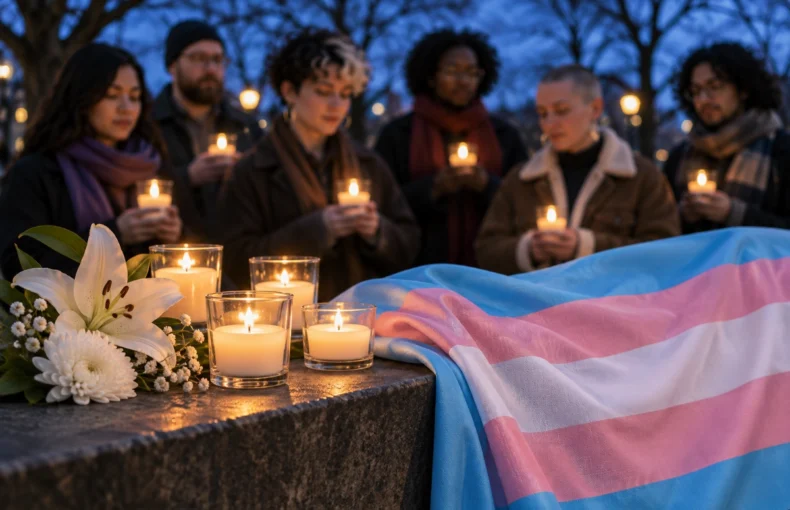
On Friday, 20 November, candles will be lit outside churches, town halls and community centres from Lisbon to Helsinki for the Transgender Day of Remembrance (TDOR), the annual commemoration of people killed in acts of anti-transgender violence. The observance, begun in 1999 by American advocate Gwendolyn Ann Smith to honour Rita Hester, a transgender woman murdered in Boston a year earlier, has grown into one of the LGBTQ+ community’s most solemn dates and in Europe, one of its most politically charged .
This year’s commemorations are already visible on calendars across the continent. In Scotland, Trans Pride Scotland, and LGBT Youth Scotland have scheduled an online vigil for the evening of 19 November, while in England, a memorial vigil is planned outside St John’s Church in Peterborough on the same date. Similar gatherings are expected in Berlin, Paris, Warsaw and beyond, many organised by groups affiliated with Trans Europe and Central Asia, TGEU, the Berlin-based network of more than 200 organisations that tracks legal recognition and safety for trans people across 50-plus countries.
A Memorial with an Unavoidable Politics
Now in its 27th year, TDOR arrives in Europe at a moment of sharpened tension. Unlike Pride, which celebrates, the Day of Remembrance mourns — and that mourning has increasingly become a site of contest between governments, activists and an emboldened political right.
In the United Kingdom, the date has even surfaced in Parliament: a written parliamentary question tabled in October 2026 pressed the Cabinet Office to disclose what it had spent on TDOR observance in 2025, part of a broader audit of government participation in LGBTQ+ awareness dates. Advocates read such scrutiny as a sign of the times; critics counter that public institutions should remain neutral on contested gender questions.
Further east, the stakes are starker. International human rights monitors recorded the October 2024 killing of Kesaria Abramidze, a well-known transgender woman, in Tbilisi — a murder that came weeks after trans activist Nata Talikishvili was assaulted in the Georgian capital. The UK Home Office‘s country guidance on Georgia, drawing on ILGA-Europe’s annual review, describes worsening conditions for LGBTQ+ people in Georgia amid political turmoil. Human rights organisations say such cases illustrate the divide the Day of Remembrance was created to highlight: the burden of lethal violence falls overwhelmingly on trans women of colour, sex workers and migrants, those with the least protection.
Data compiled by advocacy organisations, including Outright International’s recent Killed for Who They Are” report, which documents more than 230 targeted killings of LGBTIQ people worldwide between January 2020 and July 2026 and notes that 70% of Mexico’s 2024 killings had led to no prosecution as of September 2025, emphasises both the scale of the violence and its invisibility: many deaths are never formally documented as hate crimes, and prosecutions frequently stall.
The Scandinavian Paradox
Nowhere is Europe’s complicated relationship with transgender rights more visible than in Scandinavia, a region famed for progressive consensus, now wrestling openly with the limits of that reputation.
Sweden, long the first country to permit legal gender change (in 1972), has been at the centre of Europe’s most consequential policy shift of recent years. In 2022 the Swedish National Board of Health and Welfare concluded that the risks of puberty blockers and hormones for minors currently outweigh the benefits, sharply restricting such treatment, a determination that has echoed through health ministries across the continent. Yet in the same period Sweden’s parliament passed a new gender-recognition law easing the process for adults, effective from 2025, showing that caution on youth medicine and liberalisation on legal status can travel together.
Norway, which adopted self-declaration of legal gender as early as 2016, has likewise tightened guidance on medical treatment for under-18s while maintaining robust anti-discrimination protections. The European Commission against Racism and Intolerance (ECRI), in its most recent report on Norway, published in October 2026, urged the authorities to strengthen hate-speech and hate-crime legislation, a reminder that even the Nordic welfare states are not immune to the rise in anti-LGBT+ hostility documented elsewhere in Europe.
Denmark, the first country in the world to allow legal gender change on the basis of self-declaration alone (2014), introduced official guidelines in 2023 discouraging puberty-suppressing treatment for minors outside research settings. Danish clinicians and commentators have been candid that the region’s consensus, built on trust in state institutions, is being tested by an increasingly polarised public debate.
Finland reversed course earlier than its neighbours: in 2020 the national health authority COHERE declared psychosocial support the first-line treatment for gender-dysphoric youth, and in 2023 parliament passed a self-identification law, which took effect in 2024, replacing a decades-old sterilisation requirement.
Iceland, by contrast, has moved in the opposite direction, with among the most permissive gender-affirming care frameworks in Europe.
Between Memorials and Milestones
Across the wider continent, the legal landscape remains starkly uneven. Germany, Spain and Belgium have adopted self-identification models; Hungary has moved to ban legal recognition and «promotion» of LGBT+ content; and courts at the European Court of Human Rights, continue to hear cases testing how far member states must go in protecting and recognising trans citizens.
For organisers of this week’s vigils, the message is deliberately simple and unsentimental: on 20 November, before the politics resumes, the names will be read aloud.
As one Scottish organiser put it in announcing this year’s online vigil : «We gather to honour and remember trans lives lost — and to insist that remembering is only the beginning».
Sources:  Gayety, TGEU, Outright International, UK Parliament, Gov.uk, ECRI