Photo credit
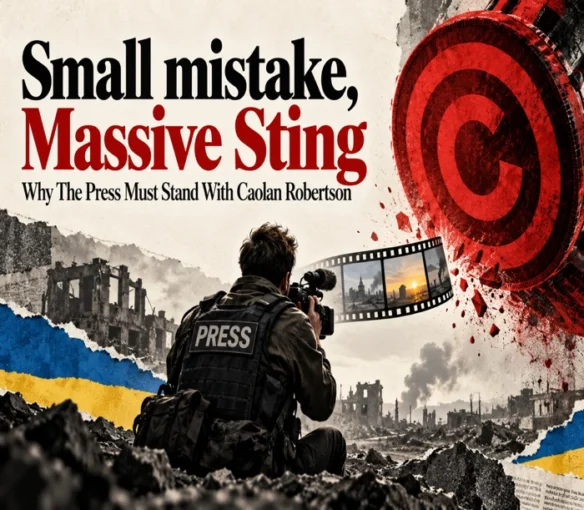
Illustration are created by AI
Small mistake, Massive Sting : Why The Press Must Stand With Caolan Robertson
A Five-Second Clip Becomes a Career Threat: When Copyright Enforcement Crosses the Line From Protection to Punishment.
Independent journalist Caolan Robertson faces a YouTube copyright strike after using four seconds of Kyiv Independent footage. We examine whether fair use and journalistic solidarity should override aggressive enforcement tactics threatening frontline reporters' careers.
A four-to-five-second clip. A cropped logo. A YouTube copyright strike that threatens an entire career.
This is the story of how The Kyiv Independent, a publication that demands sympathy for its struggle on the Ukrainian frontlines, allegedly unleashed a disproportionate hammer blow against independent war journalist Caolan Robertson — and why the wider press community should be deeply concerned.
The Incident
On 29 October 2026, Olga Rudenko, editor of The Kyiv Independent, took to social media to announce that Robertson’s channel had used «four to five seconds» of an animated map from their video «without permission» and «cropped out our logo».
Their response? A YouTube copyright claim that deleted Robertson’s video and slapped a copyright strike on his entire channel.
One strike means three strikes and your channel is gone. Three strikes means years of reporting, investigation, and risk-taking — wiped out.
But here’s what matters: four to five seconds of video sits at the outer edge of what copyright exceptions were designed to tolerate, short, incidental, and dwarfed by the surrounding original work.
And let’s be crystal clear about what this video actually was:
More than 99.9% of the video was created by Caolan Robertson himself. That borrowed clip was the tiniest sliver of a massive piece of original reporting work.
The Criticism
Robertson’s response was measured. Too measured, perhaps.
«My Ukrainian editor used five seconds of your animated map and cropped out your logo. I didn’t know, and I didn’t catch it. That was wrong. He’s apologised, and I take responsibility…»
He admitted fault. He accepted blame. He called for private resolution.
What did he get in return? Public condemnation. A copyright strike. No apparent willingness to discuss.
«I emailed your organisation seeking a resolution. I received no response, but you’ve found the time to publicly accuse me of lacking respect for journalism». — Caolan Robertson
The Fair Dealing Factor
First, a myth-buster: Britain and Europe do not have American-style «fair use». There is no open-ended defence. Instead, both systems use a closed list of specific exceptions, «fair dealing» in the UK, and a menu of permitted uses across the EU.
Under the UK’s Copyright, Designs and Patents Act 1988, the relevant provisions are Section 30(1ZA) (quotation), Section 30(2) (criticism and review) and Section 30(3) (reporting current events), plus Section 31 (incidental inclusion). All are qualified by a requirement of fairness and proportionality.
Four to five seconds embedded in a multi-minute documentary about the war in Ukraine looks, on its face, like exactly the kind of short extract these exceptions exist to permit.
Yet Kyiv Independent bypassed dialogue and went straight to YouTube’s automated dispute system. They weaponised a platform designed to protect creators against pirates, turning it against a fellow war correspondent.
Is this really how professional journalism defends its intellectual property? Or is this bullying by algorithm?
The European Angle: What Brussels Says About Short Extracts
Britain may have left the EU, but the bloc’s copyright framework still governs the other 27 member states and it is strikingly protective of short extracts.
Article 5(3)(c) and (d) of the InfoSoc Directive (2001/29/EC) permit quotation for criticism or review, and use in connection with the reporting of current events, provided the use is proportionate to the purpose and the source is indicated.
Then came the Digital Single Market Directive (EU) 2019/790, which tightened things for big platforms while carving out breathing room for small ones.
Article 15 created a new press publishers’ right, the so-called «link tax», giving news organisations control over online reuse of their output. But Article 15(2)(b) expressly excludes “individual words or very short extracts” from that right. In plain English: Brussels deliberately refused to hand publishers a monopoly over fragments.
Article 17(7) goes further still, requiring that quotation, criticism, review, caricature, parody and pastiche remain available to users when platforms police infringing content. The EU legislator’s clear intent was to stop automated takedowns from swallowing legitimate expression.
In other words, the European rulebook recognises that journalism is built from fragments and that punishing every fragment chills the very reporting the law is meant to protect.
Critics will point, fairly, to the strongest counter-argument: quotation exceptions typically require the source to be identified, and the logo here was reportedly cropped out. That is a genuine flaw and Robertson has acknowledged it, apologised for it, and offered to resolve it privately. The question is not whether the crop was careless. It plainly was. The question is whether carelessness warrants a strike that can erase an entire channel.
The Double Standard?
Here is where this gets uncomfortable for established media.
Commenters on the thread have pointed to prior allegations that Kyiv Independent itself has used researcher work without proper attribution, including claims that someone spent «THOUSANDS of hours» on research that was later published without credit.
One commenter wrote: «Bro, you talked to my friend about his personal research that took him THOUSANDS of hours to do, you published the results as your own, and then when he talked to you again you pretended you had never heard of him or spoken to him before».
Whether these claims are verified remains unclear, but the perception matters. When an outlet positions itself as defending journalistic ethics while facing accusations of similar conduct, credibility takes a hit.
Why Independent Journalists Matter
Caolan Robertson operates without the backing of major media institutions. He works independently. He takes risks on the ground. He builds trust with audiences over years.
His video was 99.9%+ original content — his own reporting, his own filming, his own narrative. Yet a tiny accidental slip of four seconds threatens to delete it all.
A single copyright strike threatens everything.
Is the goal truly to protect intellectual property? Or is it to silence dissenting voices in an increasingly crowded war reporting space?
Kyiv Independent writes: «We’re independent, funded mostly by our readers, and we earn every dime».
So does Robertson. So do countless others doing dangerous work in Ukraine.
The Real Question
Should a four-to-five-second clip, mistakenly used, quickly admitted, formally apologised for, and plausibly covered by quotation and current-events exceptions in both UK and EU law, warrant a nuclear-option copyright strike?
When over 99.9% of the work is original to the creator, does aggressive enforcement serve justice or simply intimidate competition?
Or should journalism have room for error, for correction, for human fallibility?
We believe the answer is clear. The professional press has a duty to defend independent journalists who make honest mistakes — especially when those mistakes are acknowledged and rectified, and especially when the law’s own exceptions lean towards tolerance.
Kyiv Independent had every right to expect credit. But credit does not require destruction of a fellow journalist’s platform.
Support For The LGBTQ Community
It’s also worth noting that Caolan Robertson has been a vocal supporter of LGBTQ rights in Ukraine, advocating for equal treatment and visibility in war-torn communities. Standing against disproportionate punishment is also standing in solidarity with journalists who champion inclusivity and human dignity.
Call To Action
To The Kyiv Independent: Retract the complaint. Remove the strike. Respect the exceptions.
To the broader media ecosystem: Stand with independent reporters who operate on the frontlines with limited resources and zero institutional protection.
Journalistic solidarity should extend beyond paid staff and established outlets. It should reach everyone risking their reputation — and sometimes their lives — to tell the truth about Ukraine.
Because today it’s Caolan Robertson. Tomorrow it could be any of us.
The Kyiv Independent can not use or refer on any site to this article without written consent from the editor of this outlet. Other outlet can freely refer or mention this article without written permission from the editor.
Sources:  Twitter Olga Rudenko (@olya_rudenko), Caolan Robertson (@CaolanReports)