Far-Right AfD Storms to Historic German Election Win, as Neo-Nazi Links Come Back to Haunt Them
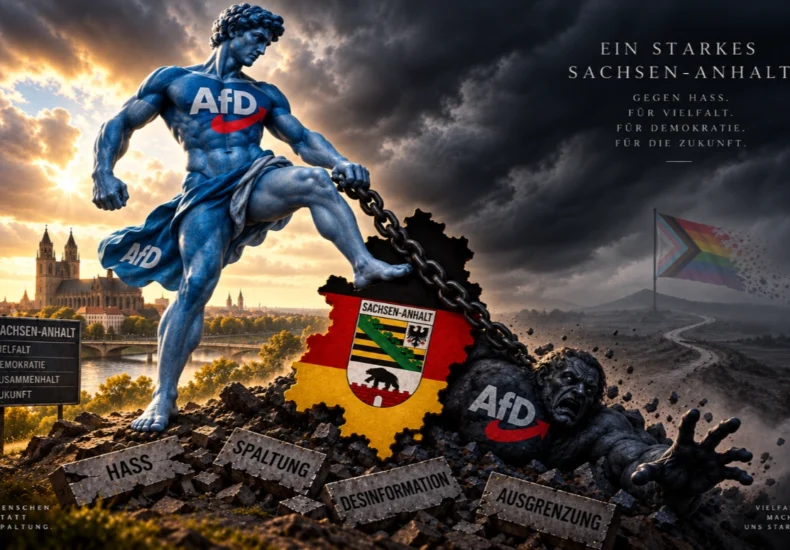
The Alternative für Deutschland has taken Saxony-Anhalt in a seismic result, the first far-right victory at state level since the Second World War, despite a campaign dogged by revelations about neo-Nazi ties and an openly anti-LGBTQ manifesto.
Europe woke up to a political earthquake on Monday morning after Germany’s far-right Alternative für Deutschland (AfD) swept to victory in the eastern state of Saxony-Anhalt, with exit polls putting the party on a staggering 44.5 per cent of the vote — more than double Chancellor Friedrich Merz’s slumping CDU, according to DW.
It is the first time a far-right party has topped a state election in Germany since the fall of the Third Reich, though, as The Guardian reports, the AfD fell just short of the absolute majority needed to govern alone, leaving its path to power dependent on coalition maths in Magdeburg.
Leading the charge is the party’s grinning lead candidate, Ulrich Siegmund and it is his colourful circle of associates that has alarmed observers from Brussels to Warsaw.
The Neo-Nazi Skeletons in the Cupboard
While Siegmund campaigned on sunny images riding a powder-blue moped down country lanes, an explosive investigation by The New York Times revealed that he and his state party remain privately close to figures from the furthest extremes of German politics, including a campaign spokesman and party lawyer who were members of a youth group inspired by the Hitler Youth.
Confronted with the findings, Siegmund defended his associates to Die Welt as «outstanding people, reportedly saying he is «not interested in what happened 20 or 25 years ago».
And there’s more. According to analysis by the Brookings Institution, the chant «Sieg! Mund!» has become a frequent refrain at AfD rallies across the state, an unmistakable echo of a certain historical slogan that Siegmund, remarkably, claims not to hear. Both Siegmund and fellow AfD figure Hans-Thomas Tillschneider have also refused to disavow links to extremist movements such as the Identitarian Movement and the Saxon Separatists, Brookings reports.
The party’s extremist pedigree doesn’t stop at the state border. One of its most prominent national figures, Björn Höcke, has twice been convicted over the use of a banned Nazi-era slogan whose public use is a criminal offence, as detailed in Wikipedia’s entry on the politician.
The War on «Wokeism» : AfD Declares Battle Against LGBTQ Community
Perhaps nothing reveals the party’s worldview more starkly than its treatment of the LGBTQ community. The AfD’s adopted manifesto for Saxony-Anhalt, described as «radical» by the BBC , brands homosexuality a «sexual deviation» and laments that «non-reproductive lifestyles» have been aggressively promoted over “normal family” structures.
Under an AfD government, the rainbow pride flag would be banned from flying at schools, the manifesto declares, while lessons on transgender people would be confined to the science department, as outlined by The Telegraph.
Given the party would control education, policing and culture in the state, these aren’t idle threats. Critics warn the plans amount to state-sanctioned marginalisation of queer Germans, with 52 per cent of men under 25 in the state having backed the AfD, the very generation that came of age in an open, diverse Europe is decisively split.
Courts, Spooks and a Party Under Watch
Back in 2023, the Office for the Protection of the Constitution in Saxony-Anhalt classified the AfD’s state branch as a «far-right extremist organisation», with the national party similarly designated «confirmed right-wing extremist», a designation currently suspended under a temporary court injunction, as the BBC reports.
The manifesto has raised eyebrows too, demanding children of asylum seekers be taught in «special classes» and restricting school trips to memorial sites, which the party claims turn young people into «memorial zombies». Trade unions, churches and civil society groups have mobilised against the party’s rise, with hundreds protesting outside its party conference and thousands gathering in Magdeburg on the eve of the vote, according to the BBC and DW.
Europe Looks On Nervously
The ripples are being felt well beyond Germany’s borders. France’s Europe Minister Benjamin Haddad called the result «a serious moment in Europe», according to DW.
Alarm is heightened by the AfD’s reported pledge of closer ties with Moscow, alongside promises of mass deportations, a ban on LGBT symbols and classroom segregation, as outlined by The Telegraph.
What Happens Next?
With no rival party willing to enter coalition with the far right, Saxony-Anhalt faces weeks of political horse-trading and possibly a snap election, after Siegmund rejected a coalition overture from the BSW. But whatever happens in Magdeburg, the message from German voters is chillingly clear, and the AfD is already eyeing national power: co-chair Alice Weidel declared Saxony-Anhalt «only the beginning», according to Brookings.
One thing is certain: eight decades after the Second World War, Germany and Europe, has just entered a new and deeply uncomfortable era.
Most Popular
- Books & Literature
Campaigners To Write Book Telling Australia’s Marriage Equality Story
- World - LGBTQ Rights
Homophobic Uganda Should Reject Sexual Offences Bill
- Music Video
Osher Sebbag – «I’m not your top»
- USA - LGBTQ Rights
United States: State Laws Threaten LGBT Equality




Must Reads
- Music Video
Lyle Anthony – «My Forever»